Video Poker
• Hand ranks
• Procedure of play
• Different video poker games
• What determines the payout?
• Practise, practise, practise
• Volatility
• Useful video poker resources
This page is a general introduction to videopoker. There are several references to paytables and strategies, explanations for which can all be found on the Jacks Or Better page.
The layout of the game
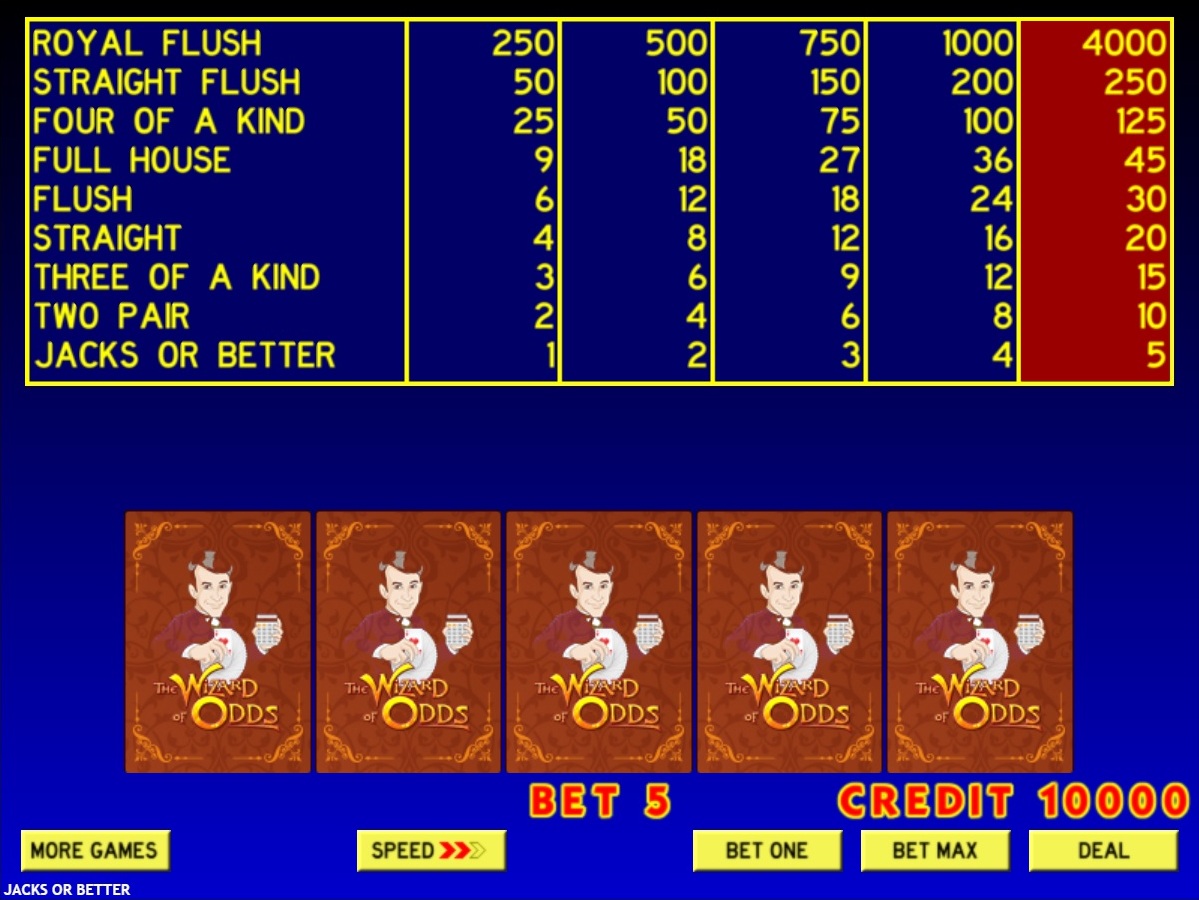
Video poker is cross between a slot machine and a poker game: the format is that of a slot machine, with screen, buttons and coin drop, but the standard slot machine symbols are replaced by varying ranks of poker hands along with the corresponding payoff for each hand located to its right - collectively referred to as the “paytable”.
As such, video poker differs from table poker in that the payoffs you receive for any winning hand are always a fixed amount, determined by the paytable, and not dependent on however much money there is in the pot of the live game.
Hand ranks
The hierarchy of video poker hand ranks corresponds to table poker:
| Royal flush |
| Straight flush |
| Four of a kind |
| Full house |
| Flush |
| Straight |
| Three of a kind |
| Two pair |
| Pair |
Some games contain “wildcards” or “jokers” (see the section on different games below), in which case certain other hand types come into play:
• Four deuces (the four wildcards in Deuces Wild)
• Five of a kind (a joker or wildcards together with cards of the same rank)
• Joker royal (a joker with four suited royal cards)
• Wild royal (a combination of court cards and wildcards)
Procedure of play
You are dealt five initial cards, of which you can then hold or discard as many as you choose. If you have a made hand - such as a full house - hold all five cards. If you have nothing worth holding, discard them all and draw five new cards. Each card you discard is then replaced by another card from the pack, and your new selection of five cards represents your final hand.
Any winning hand is paid out according to the paytable, after which you proceed to the next hand.
Here is a graphic illustration of the above process:

This is a typical initial screen; some software types require you to physically insert “coins” into the machine; others simply let you play directly from your balance. You now have two options: “bet max” or “bet one”; always click on “bet max” (see the Jacks Or Better page for an explanation of this) -

The machine deals your initial five cards and the paytable lights up any paying hand you've been dealt - on this occasion, a Jacks Or Better pair, two queens. At this point you have to make your decision about which cards to discard and which to hold; in this case...

...you hold the pair of queens and then click the “draw” button to replace the three discards with three new cards from the deck:

The machine deals you the replacement cards, and the new five-card combination represents your final hand - in this case, I converted a high pair into a full house and was paid $45 for my $5 initial bet - 9:1.
Different video poker games
There is a vast array of different video pokers, all of which derive from the basic Jacks or Better game and all of which are created by simply varying the paytable. The non-wildcard variants assign higher payouts to the higher paying hands, like four of a kind, while downgrading the lower paying hands, which creates a more volatile game. All American, Double Bonus and Aces & Eights are examples of such games.
In addition to these basic offerings, there are the “wildcard” games where one of the standard cards - usually the 2 or the 7 - takes the value of whichever card gives the hand its highest value and where the wildcards themselves can act as a mini jackpot. Then there are the “joker” games, where the non-standard joker card is added into the mix as another wildcard, which then creates higher paying hands and mini jackpots in similar fasion to when the deuces and the 7s act as wildcards. Deuces Wild, Loose Deuces, Joker Wild and Deuces & Joker Wild are examples of these slightly more turbo-charged video pokers.
Crucuially, even the smallest change to a videopoker paytable usually necessitates a change in strategy.
What determines the payout?
Two factors determine the payout of any video poker machine: paytable and player strategy. Each paytable has a maximum payout that can be achieved with optimum strategy; the best payout achievable on the standard Jacks Or Better 9/6 paytable is 99.54% - with perfect strategy; make mistakes and you will not achieve that payout.
Learning correct strategy can be quite a task but it's worth it; not only will you achieve the best payout possible, but in addition there are video poker games with payouts well above 99.54%.
Practise, practise, practise
Playing perfect video poker isn't easy, and I heartily recommend that you do not jump straight in at the deep end wagering with real money. Practise first and monitor your play for accuracy.
Michael Shakelford has a full suite of video poker practice tools available for free play which look like they’ve been licensed from Bob Dancer's “Winpoker” software. Winpoker itself no longer exists so it's good to see it with a new home -
It plays basically the same as normal video poker - you bet “max”, after which you can choose to “analyse” the hand for perfect play or simply “draw”. There’s also a “warn on strategy errors” box directly above the machine that you tick if you want to know when you’re making a mistake, as well as many other game options available.
Never play video poker on a whim. Assuming at some point you want to play games other than those discussed on this site, ensure that you know both the average payout of the game and the optimal strategy to achieve that payout. Failing both these you'll find yourself swimming expensively in the dark
Volatility
Video poker is highly volatile. A large chunk of that average payout is tied up in the royal flush - usually about 2%. Royal flushes occur approximately once in every 40,000 hands, which means you'll play an awful lot of hands without a significant portion of your payout as you wait for the allusive royal to hit. It's possible to play even 200,000 without hitting one. At the same time, it's just as possible - more so, in fact - to hit ten or more.
The point of all this?
Expect large swings in your bankroll. Playing winning video poker is not for the faint-hearted.
Useful video poker resources on the web
• The Wizard Of Odds
Video Poker homepage, where Shackleford's usual goldmine of information, analysis, tools and calculators are listed.
Video Poker analyzer is a tool which analyses any paytable you choose, giving frequency and percentage returns for each hand.
Video Poker hand analyzer analyzes any hand of any of the listed games, with the added option of being able to customise the paytable. The analysis lists the best play down to the worst, with percentage return figures.
Video poker strategy calculator is, I think, the piece de resistance of the tools on offer: after selecting and, if required, customising the paytable of a large selection of games, it generates percentage and returns analysis for both optimal and “basic” play (play which disregards the various exceptions required for optimal return), followed by a full hand rank basic strategy chart and finally all the exceptions for perfect play. And it's all freely available.
Risk of ruin tables for jacks or better, double bonus and deuces wild, calculated on both the gameplay alone and also with various amounts of cashback included.
• Beating bonuses
Video poker strategy calculator, another freely available tool that allows you to select games (including an additional categorisation by specific online software provider), analyse any hand, customise the paytable and generate frequency and return tables.
Video poker payout calculator generates frequency and return tables for a large variety of games and the versions as offered by the various online software providers.
Video poker strategy practice is a training tool which gives the correct play whether or not your choice was correct, allows you to modify the paytable and lists your play statistics for the current session, a feature which includes recalculation of the EV lost to playing errors as the hands progress.
Page top
© 2005 - 2026 Hundred Percent Gambling