•
•
Gambling myths 1: the "law of averages" or the "law of large numbers"?
 When we talk about the "average" or "expected" return of a gambling
game we're thinking very much long-term. We are NOT talking
one session of 200 hands, or even a hundred sessions of 20,000 hands. This
all comes down to an important principle, the Law Of Large Numbers (LOLN),
which states that the more trials you undertake of a given event, the
more your actual percentage return will converge to the theoretical expected return
of the event in question. In real terms: if you play a blackjack game with
an expected return of 99.94%, the more you play that game the more your
results will converge to that 99.94% figure. After 200 hands you most probably
will not be sitting at 99.94%. After 200,000,000 hands you most probably
will be pretty close!
When we talk about the "average" or "expected" return of a gambling
game we're thinking very much long-term. We are NOT talking
one session of 200 hands, or even a hundred sessions of 20,000 hands. This
all comes down to an important principle, the Law Of Large Numbers (LOLN),
which states that the more trials you undertake of a given event, the
more your actual percentage return will converge to the theoretical expected return
of the event in question. In real terms: if you play a blackjack game with
an expected return of 99.94%, the more you play that game the more your
results will converge to that 99.94% figure. After 200 hands you most probably
will not be sitting at 99.94%. After 200,000,000 hands you most probably
will be pretty close!This can be illustrated with a simple experiment that shouldn't take more than five minutes: toss a coin twenty times and record the results. Here's a table for a run I did myself - the first column records the winning side, the second shows the number of heads against the total number of tosses, the third indicates the percentage this represents of the total and the last column demonstrates the extent that the actual results diverge from theoretical expectation.
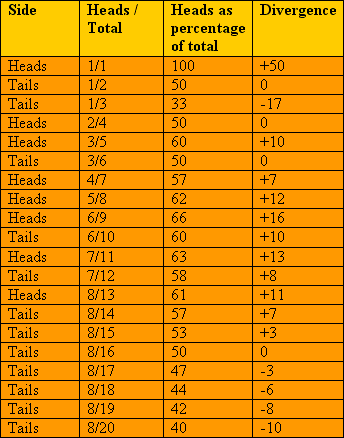
The first few results jump all over the place: 50 up, 50 down, 17 up, 17 down, 10 up. Towards the end, the movement around and about the "average", 50, is much slower, moving in steps of two. The actual monetary value of the bets obviously remains the same, but since each individual bet gets smaller, in relation to the overall body of results, after each subsequent toss, the percentage difference gets smaller in relation.
NB: The percentage difference gets smaller. Not the actual difference.
This can be illustrated by isolating the "divergence" column in graph format:
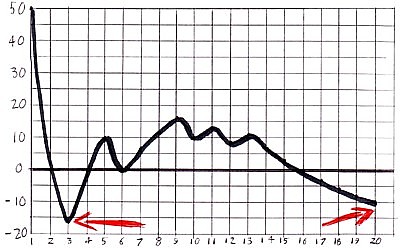
"0" represents the "average" point - equal numbers of heads and tails; the red arrows highlight the two lowest points. The first low point, at 17% "out", is at the point of the third toss, where the actual results are one head out of a total of three tosses; the "average" rate is 1.5 heads at this point, so we're only 0.5 tosses out, but the percentage divergence is substantial, at 17%. Later on in the graph, on the last toss, the results are 8 heads out of 20. The expected number of heads at this point is 10, so we're now two out - which is four times greater than the previous one in terms of ACTUAL tosses. However, since we're much further into the "long run" at this point, the percentage divergence has in fact DECREASED, from 17% down to 10%.
The actual divergence has INcreased, but the percentage divergence has DEcreased!
 All of that may seem excessively and unnecessarily complex; however, it's worth trying to
get your head around it, because misconception of the LOLN manifests itself
in the "law of averages", the downfall of many, many a gambler. The "law
of averages" states that the "luck evens out"; if you've had a rotten session,
you'll have a good session to balance things, because the good cards
are now somehow "overdue"; consequently, many a gambler on the receiving end of a bad session
of cards will start to increase his wagers in the belief that he'll recoup
his losses when the luck turns and evens things out. This is a dangerous
misconception. The luck does not even out. You do not win ten after losing
ten, or lose fifteen after winning fifteen. The percentages even out, according
to the LOLN - as illustrated in the above example. However, the actual financial returns
do not. Your results simply get
closer and closer to your expected percentage return the
more you play. Yes, there are good sessions and bad sessions. Yes, if you
have a bad session there is absolutely no reason to suppose you won't have
a good session - but do NOT fall into the trap of believing in the flawed "law
of averages".
All of that may seem excessively and unnecessarily complex; however, it's worth trying to
get your head around it, because misconception of the LOLN manifests itself
in the "law of averages", the downfall of many, many a gambler. The "law
of averages" states that the "luck evens out"; if you've had a rotten session,
you'll have a good session to balance things, because the good cards
are now somehow "overdue"; consequently, many a gambler on the receiving end of a bad session
of cards will start to increase his wagers in the belief that he'll recoup
his losses when the luck turns and evens things out. This is a dangerous
misconception. The luck does not even out. You do not win ten after losing
ten, or lose fifteen after winning fifteen. The percentages even out, according
to the LOLN - as illustrated in the above example. However, the actual financial returns
do not. Your results simply get
closer and closer to your expected percentage return the
more you play. Yes, there are good sessions and bad sessions. Yes, if you
have a bad session there is absolutely no reason to suppose you won't have
a good session - but do NOT fall into the trap of believing in the flawed "law
of averages".Page top
<< Back to the Gambling Myths page
© 2005 hundred percent gambling